Wastewater treatment solves one problem, but it also creates another material that has to be dealt with carefully: sludge. For industries, municipalities and institutions operating treatment plants, what happens to those separated solids can influence operating costs, compliance, plant reliability and even the feasibility of water reuse. Ion Exchange approaches sludge treatment as an integral part of wastewater management rather than something that begins only after the water has been treated. That distinction matters because poorly managed sludge can quickly become an operational bottleneck.
So, what exactly is sludge, why does a treatment plant produce it, and what happens to it once it leaves a clarifier? The answer is more interesting — and more important — than simply sending it away for disposal.
What Is Sludge?
Sludge is the semi-solid material separated from water or wastewater during physical, chemical or biological treatment. It generally contains water, suspended solids, organic matter, microorganisms and other substances removed from the wastewater stream.
The precise composition hinges upon the origin of the wastewater. Wastewater treatment plants are usually responsible for producing sludge rich in organic compounds, microorganisms and nutrients. When it comes to industrial facilities it is common that sludge is generated with different chemicals, oils, metals and some other impurities which depend on the type of production.
That is why there is no such treatment technology which can be effective for all plants. For example, the sludge coming from the food industry will not behave in the same way as sludge from the metal production.
Thus, the first task is not simply removing the sludge. Understanding sludge is necessary.
Why Does Sludge Need to Be Treated?
Fresh sludge typically contains a large amount of water. Moving, storing or disposing of that material without further treatment can therefore become expensive surprisingly quickly.
There are other concerns too. Untreated organic sludge can decompose, create odours and contain microorganisms that require proper control. Industrial sludge may also contain contaminants that influence how it can ultimately be handled.
Good sludge management is designed to reduce these risks while making the remaining solids easier and more economical to handle.
In practical terms, treatment usually aims to:
- reduce sludge volume and water content;
- stabilise biodegradable organic matter;
- improve handling and dewatering characteristics;
- control odour and biological activity;
- prepare the solids for compliant reuse, recovery or disposal.
Removing water early in the process can be particularly valuable because it reduces the amount of material that must be processed, transported or stored.
Sludge Treatment Process: How Is Sludge Treated?
Ask plant operators how is sludge treated, and the answer will rarely be a single piece of equipment. Treatment normally involves several stages, selected according to sludge characteristics, plant capacity and the final disposal or recovery route.
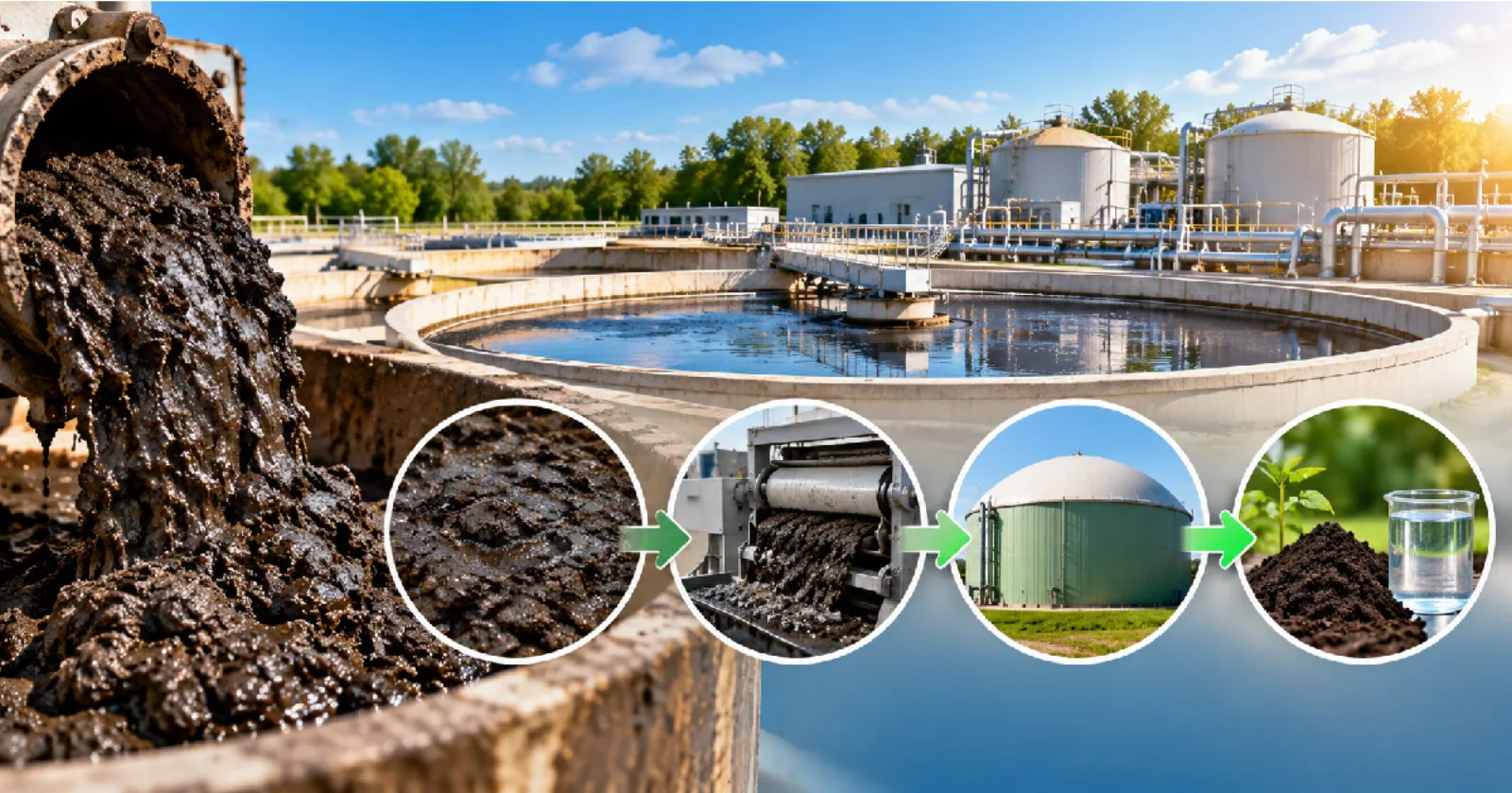
A typical sludge treatment process can include thickening, conditioning, stabilisation, dewatering, drying and final management.
1. Sludge Thickening
Thickening is often the starting point.
At this stage, part of the water is separated from the sludge so that the solids become more concentrated. Gravity thickeners, dissolved air flotation systems and centrifuges are among the technologies that may be used.
Why do this before anything else?
Because processing unnecessary water costs money. A smaller sludge volume can reduce the load placed on downstream digesters, dewatering equipment, tanks and transportation systems.
2. Conditioning
Some types of sludge are not very free-draining, which is where conditioning becomes useful. Conditioning involves adding an agent, such as a polymer, to alter the sludge's physical properties and enhance solid-liquid separation. If the right conditioning system is used, subsequent dewatering can become much more efficient.
This step may seem minor when compared to either digestion or mechanical dewatering, but it must still be done properly. If incorrect chemicals are chosen or the wrong amount is used, the wrong result might be achieved.
3. Stabilisation and Digestion
Organic sludge may need to be stabilised before final handling.
Aerobic and anaerobic digestion are commonly used biological approaches. During digestion, microorganisms break down biodegradable organic matter, reducing the sludge's tendency to putrefy and helping control odour and biological activity.
Anaerobic digestion has another potential advantage: organic matter can be converted partly into biogas containing methane, creating opportunities for energy recovery where plant scale and process economics justify it.
For sewage sludge, stabilisation is particularly important when the intended downstream route requires better control of pathogens, odours or biodegradable material.
4. Sludge Dewatering
Once sludge has been thickened or stabilised, considerably more water can be removed through mechanical dewatering.
Equipment may include:
- filter presses;
- belt filter presses;
- centrifuges;
- vacuum filtration systems;
- drying beds.
The goal is usually to turn a pumpable sludge into a more manageable sludge cake.
That change has a very practical commercial impact. Less water means less material occupying storage space and less weight or volume requiring transportation. Dewatering can therefore affect both plant efficiency and the economics of final disposal.
5. Drying and Further Treatment
Some facilities need to reduce moisture even further.
Natural drying beds, mechanical drying, or thermal processes can be chosen based on the characteristics of the sludge and its intended end use. Composting is also an option if the sludge has properly stabilized organic content, taking into consideration any relevant quality regulation.
This is when the issue of sludge treatment gets very site-specific. Getting completely dry sludge is of little importance if the cost of excess water is more than the benefits from its dewatering. However, the opposite is also true; stopping the dewatering process too soon will leave the facility paying, and paying, and paying for the water that it has to dispose of.
Choosing the right level of dewatering must depend on the entire sludge process and not only on the working characteristics of a unit of equipment.
What Happens to Sludge After Treatment?
There is no single answer.
Sludge that has undergone treatment may be subjected to different forms of disposal: it can be treated properly, incinerated, composted, or reused, depending on its specifications as well as local regulations.
When discussing the aforementioned process, one must not forget about the necessity for distinguishing “sludge” from “waste material”.
The process chosen depends on such parameters as contamination level, the presence of pathogens, moisture, and stability of the sludge, as well as its classification.
For example, industrial sludge containing harmful components needs a different treatment compared to organic sludge that has been treated properly.
Common Sludge Treatment Challenges
A plant may have excellent wastewater treatment performance and still struggle with its solids line.
One frequent problem is treating sludge handling as an afterthought. When sludge generation increases but thickening, storage or dewatering capacity does not, operators can face overflowing holding tanks, frequent equipment operation and higher disposal costs.
Sludge variability is another challenge. Changes in production, chemicals, biological conditions or influent characteristics can alter how easily sludge settles and dewaters.
And then there is polymer consumption. Adding more chemical does not automatically produce better dewatering. Jar testing, sludge characterisation and equipment optimisation often reveal more than simply increasing dosage.
The larger lesson? How is sludge treated should never be answered independently of how the rest of the wastewater plant operates.
How Ion Exchange Supports Better Sludge Management
Effective sludge handling works best when it is designed as part of the complete water and wastewater treatment system.
Ion Exchange has provided ultimate water and environmental management solutions for the industrial, institutional, and municipal sectors, right from waste processing and solids management.
The engineering process must incorporate several factors such as the generation rate of the sludge, composition of the sludge, availability of space, upstream treatment methods, dewatering requirements, workforce, disposal methods, and cost of life cycle of the process.
An integrated perspective could bring a real benefit to a plant manager, since even the most sophisticated machine for dewatering will be of little use if the upstream sludge cannot be properly conditioned, or if the resulting cake is unusable.
The aim is not just to put one more unit operation into work.
It is required to make a robust chain of treatment operations.
Treat Sludge as Part of the Water Strategy
Sludge may be the material left behind after wastewater treatment, but it should never be an afterthought.
Well-designed sludge treatment reduces unnecessary water, improves solids handling and can lower the burden associated with storage, transportation and final disposal. More importantly, it gives operators better control over the complete wastewater treatment process.
If sludge volumes, dewatering performance or disposal costs are becoming a recurring challenge at your facility, it may be time to look beyond individual equipment and assess the complete treatment train.
Talk to Ion Exchange about designing or optimising an integrated wastewater and sludge handling solution for your facility.
Frequently Asked Questions
1. What is sludge in wastewater treatment?
Sludge is the concentrated solid or semi-solid material separated from wastewater during treatment. It can contain water, organic matter, suspended solids, microorganisms, nutrients and other contaminants depending on the wastewater source.
2. How is sewage sludge treated?
Sewage sludge may undergo thickening, conditioning, biological stabilisation, dewatering and, where required, further drying or processing. The exact combination depends on plant design, sludge properties and the intended final disposal or beneficial-use route.
3. What are the main methods of sludge treatment?
Common methods include gravity or mechanical thickening, aerobic or anaerobic digestion, chemical conditioning, centrifugation, filter pressing, belt pressing, drying and composting. The appropriate combination depends on the type and quantity of sludge being produced.
4. Why is sludge dewatering important?
Dewatering removes a significant portion of the water held in sludge, producing a more manageable cake. This can reduce storage requirements and lower the amount of material that needs to be transported or sent for further processing.
5. What is the difference between sludge treatment and sludge disposal?
Treatment changes the sludge so it is more stable, concentrated or manageable. Disposal or beneficial use is what happens afterwards. A sound sludge strategy connects both decisions so the treatment process produces material suitable for its intended final destination.