
Thailand’s water sector is undergoing rapid transformation as cities expand, industries intensify, and climate variability intensifies. Floods, droughts, and sudden water quality fluctuations have made real-time supervision of treatment plants, distribution networks, and industrial utilities more crucial than ever.
Today, remote water monitoring systems allow operators to predict problems up to 48 hours in advance — ensuring consistent water quality, fewer breakdowns, lower operational costs, and uninterrupted supply across municipal and industrial facilities.
What Makes Remote Water Monitoring Essential?
Traditional water operations rely heavily on manual checks, physical sampling, and visual inspection. While these methods work, they are slow, reactive, and unable to detect early-stage abnormalities.
A modern remote water monitoring system changes this by providing:
- 24/7 real-time visibility
- Instant alerts
- Predictive analytics
- Automated reporting
- Reduced manual intervention
For Thailand — where water quality changes rapidly due to monsoons, industrial discharges, and fluctuating raw water sources — remote monitoring significantly improves reliability and safety.
What Do Remote Monitoring Systems Track?
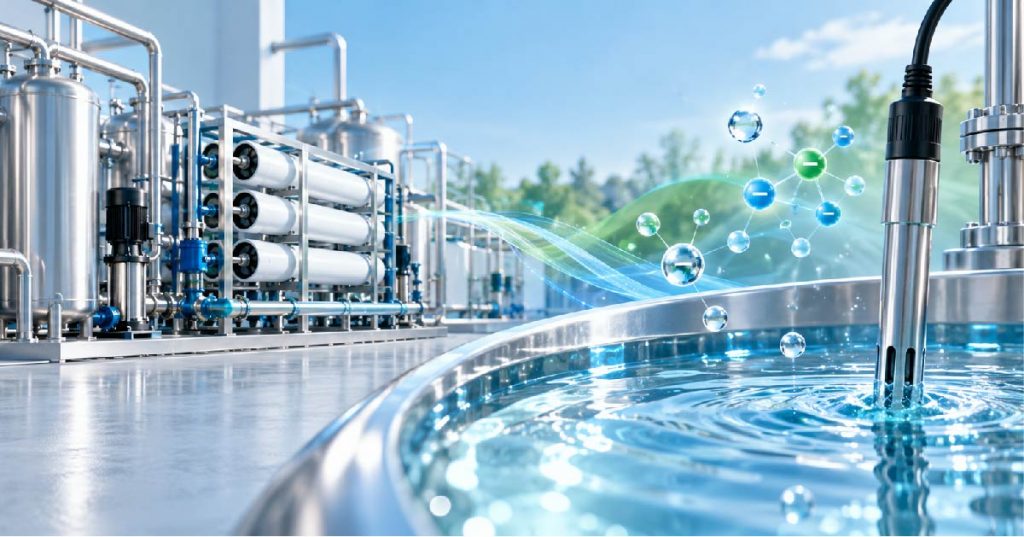
Advanced water monitoring system setups track multiple water parameters across treatment plants, pipelines, reservoirs, and industrial utilities.
Key parameters include:
- pH
- Turbidity
- Temperature
- Conductivity
- Total dissolved solids (TDS)
- Chlorine residual
- Dissolved oxygen
- Flow and pressure
- Nutrient or chemical levels (optional)
With real-time dashboards and automated alerts, these parameters help operators identify and respond to issues long before they escalate.
How Remote Water Monitoring Predicts Issues 48 Hours Early?
Predictive intelligence is the core advantage of modern remote water monitoring systems. Using sensor data, machine learning, and historical patterns, the system can detect abnormal trends and forecast failures.
Predictive functions include:
- Early Leak Detection: Pressure and flow deviations indicate possible leaks or bursts.
- Chemical Dosing Irregularities: Alerts signal when disinfectant or coagulant levels drift from safe ranges.
- Turbidity Spikes: Early detection supports timely filtration adjustments during monsoon or reservoir disturbances.
- Membrane Fouling Prediction: Useful for RO, UF, and MBR plants — enables pre-scheduled cleaning before performance drops.
- Pump or Motor Failure Forecasting: Vibration, current, and load analysis help predict mechanical failures.
This predictive capability allows operators to act 24–48 hours earlier, preventing downtime and protecting water safety standards.
Utility Monitoring Control System for Smarter Operations
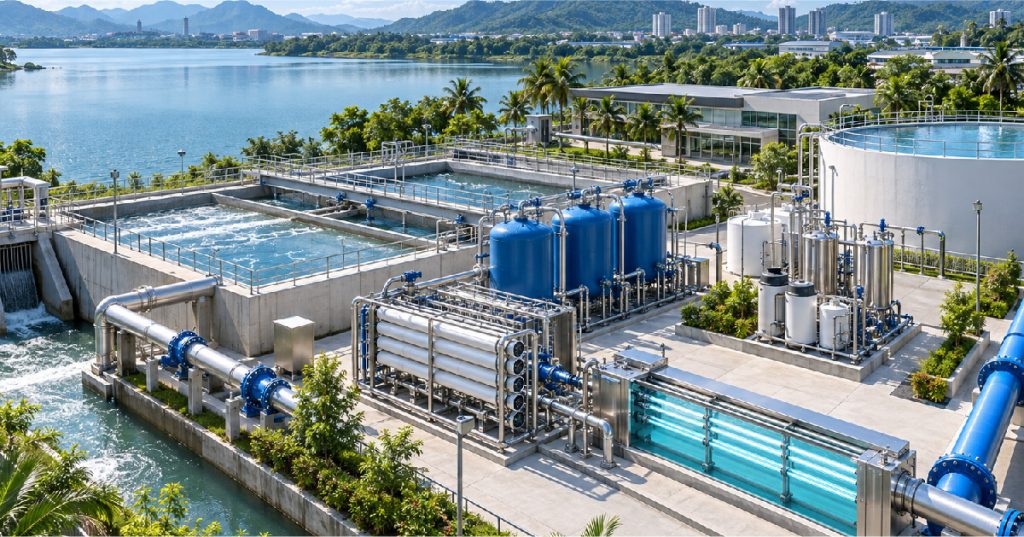
A utility monitoring control system integrates all water-related assets — pumps, blowers, chemical dosing units, membranes, clarifiers, and distribution networks — into a unified digital platform.
Benefits include:
- Automated control and optimization
- Remote start/stop of pumps and valves
- Equipment performance analysis
- Alarm management
- Reduced on-site manpower requirement
- Lower operational and energy costs
In Thailand’s expanding industrial parks, food processing zones, and manufacturing clusters, these systems ensure stable operations with minimal manual intervention.
Water Quality Monitoring for Compliance & Safety
Thailand’s industries and municipalities must meet strict water, wastewater, and reuse standards set by PCD, DIW, and local authorities. Continuous water quality monitoring helps:
- Maintain compliance
- Reduce fines or shutdown risks.
- Optimize treatment processes
- Ensure safe drinking, processing, and discharging water
With automated logging and cloud storage, plants can generate audit-ready reports instantly.
Modern Technologies Used in Thailand’s Water Monitoring System
Today’s remote water monitoring system includes:
- IoT-enabled multi-parameter sensors
- GSM/4G/5G or LPWAN communication
- PLC and SCADA integration
- Cloud data platforms
- AI/ML analytics
- Smart alarms and automated controls
These technologies help utilities and industries operate efficiently even in remote or water-stressed regions of Thailand.
Ion Exchange’s Expertise in Digital Water Monitoring
Ion Exchange supports industries and municipalities across Asia, including Thailand, with end-to-end digital monitoring solutions integrated into water and wastewater treatment systems.
Restoring Water Quality at Bhilai Water Treatment Plant
The Bhilai Water Treatment Plant, with a capacity of 144 MLD, faced persistent issues of high turbidity (5-7 NTU) and color (2025 Pt-Co) in tap water, despite relatively moderate inlet turbidity levels of 10-20 NTU. The problem was further compounded by high organic content in raw water, including fulvic and fumaric acids, leading to odor issues and a greenish tint in treated water. The high pH of 9.4 also affected coagulation efficiency, making it difficult for the existing alum and chlorination-based treatment to deliver satisfactory results.
To address these challenges, Ion Exchange India Limited (IEIL) implemented a polymer-based dosing system using INDFLOC 100A, INDFLOC 238, and INDFLOC 27, starting treatment on August 13. This optimized approach significantly improved coagulation, effectively reducing turbidity to <1 NTU (limit: 3 NTU) and colour to <2 Pt-Co (limit: 5 Pt-Co). Further enhancements included the installation of baffles for improved chemical mixing and a dosing skid with a variable frequency drive and screw pump to manage flow and dose variations efficiently.
To ensure long-term reliability, a team of experienced professionals, including chemical engineers, chemists, and technical support staff, was deployed to oversee operations. Regular maintenance, including quarterly health check-ups of the dosing system, was implemented to ensure optimal performance. Additionally, subject matter experts conducted continuous remote monitoring, analysing real-time data to maintain consistent water quality. This comprehensive approach successfully restored the plant’s ability to deliver high-quality, safe drinking water while also reducing operational costs and minimizing sludge generation. The project was executed with a well-planned investment, ensuring sustainability and efficiency in water treatment.
Integrated Waste-to-Energy Plant: Telangana
Ion Exchange (India) Ltd. launched India’s first Integrated Waste to Energy plant in Hyderabad, Telangana, at the Akshaya Patra Foundation. The design integrates state-of-the-art technologies like INDION® IPC MBR and INDION® Advanced Bio-methanation process. INDION® IPC MBR treats raw sewage and produces purified water that can be reused.
The sludge generated in the INDION IPC MBR process is combined with organic kitchen waste generated in homes and communities to recover purified water, renewable energy, and organic fertiliser. The waste-to-energy plant, which is set up at Akshaya Patra, treats wastewater and organic waste from its fully automated kitchen. The Integrated Waste to Energy plant has a capacity to treat approximately 1000 kg of organic kitchen waste and 2 – 6m3 of sewage sludge daily, and will generate approximately 20 KW/H of electrical power along with 1.35 tonnes of rich organic fertilizer per day.
This is consistent with our commitment towards SDG 7 – Affordable & Clean Energy & SDG 11 – Sustainable Cities & Communities.
Conclusion
As Thailand continues to modernise its water infrastructure, the shift toward intelligent remote water monitoring systems is essential for protecting water quality, preventing breakdowns, and sustaining operations. Predicting issues 48 hours in advance empowers operators to move from reactive problem-solving to proactive management — improving reliability, safety, and efficiency across the entire water cycle.