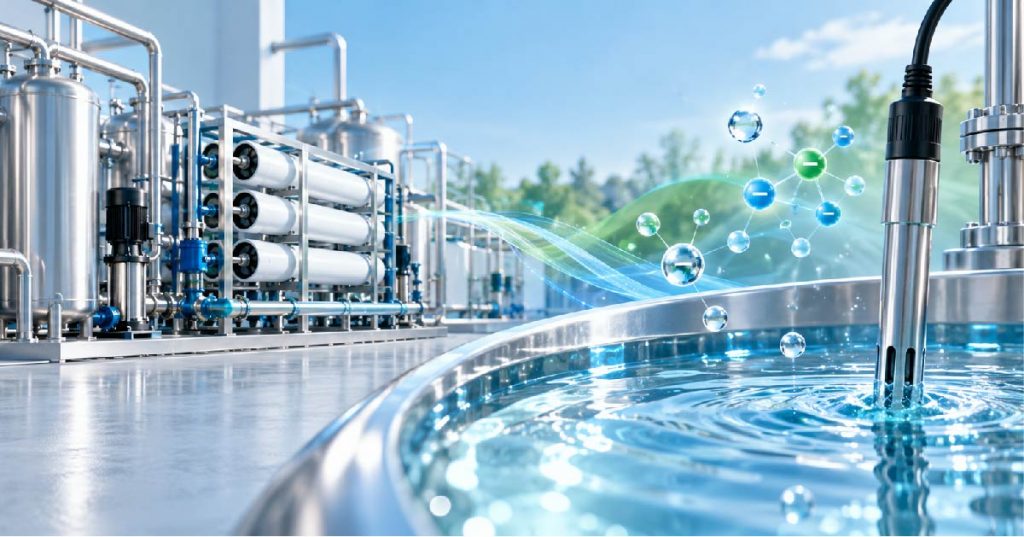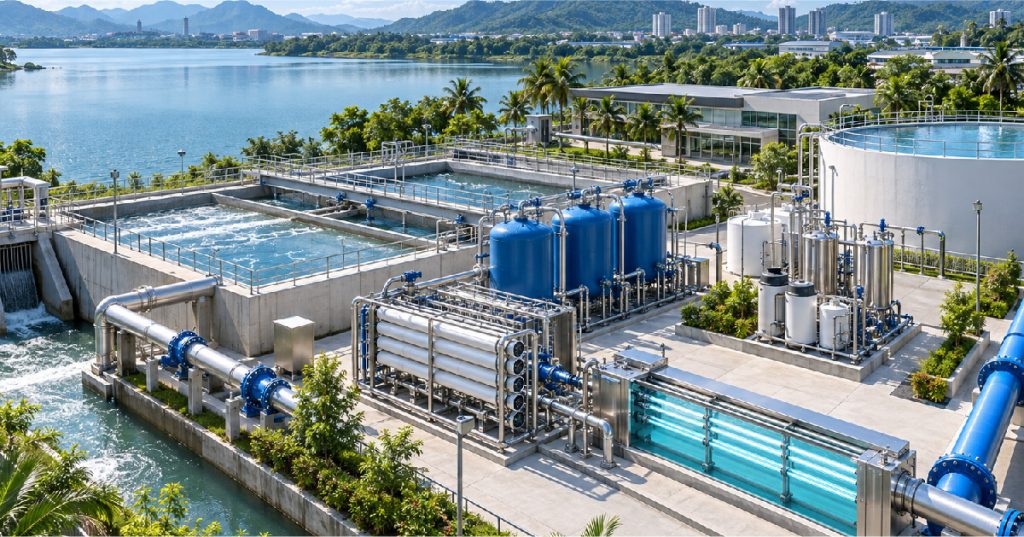

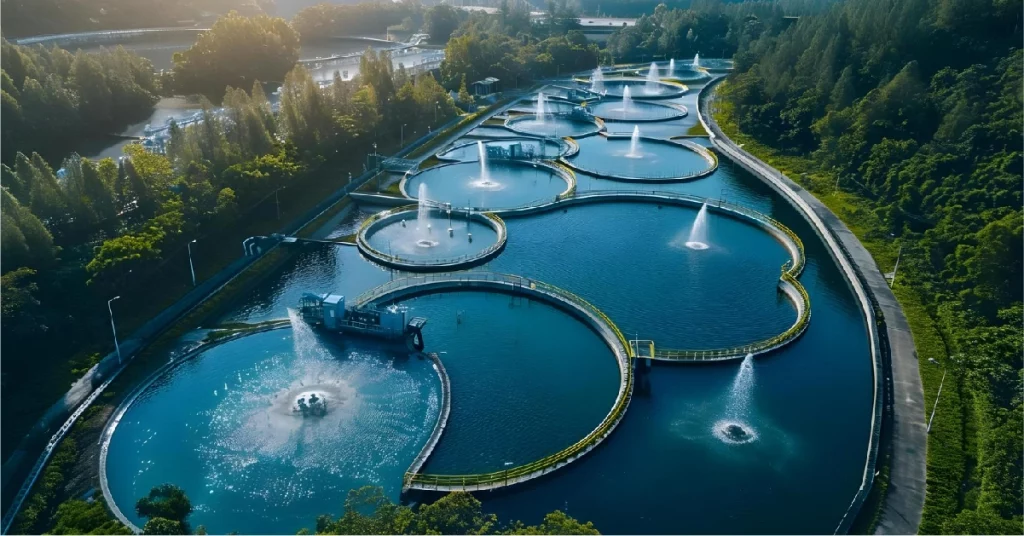
Industrial facilities require reliable water for manufacturing, utilities, cooling, boilers, and other processes. At the same time, wastewater generated during these operations must be treated before discharge or reuse.
This makes industrial water treatment in Thailand an important part of maintaining water quality, protecting equipment, and improving resource efficiency.
Modern water treatment systems combine processes such as clarification, filtration, membrane treatment, biological treatment, and disinfection according to the quality of the source water and the intended application.
Why Do Industries Need Water Treatment Systems in Thailand?
Industrial water sources can contain suspended solids, dissolved minerals, organic matter, microorganisms, and other contaminants.
Poor water quality can lead to:
- Scaling and corrosion
- Equipment performance issues
- Process contamination
- Higher maintenance requirements
- Inconsistent product quality
- Increased freshwater consumption
A properly designed water treatment plant in Thailand helps industries produce water that meets their specific process requirements while managing wastewater generated during operations.
How Industrial Water Treatment Systems Work
A typical industrial water treatment system consists of several treatment stages. The exact configuration depends on raw water quality and the required treated-water quality.
1. Raw Water Screening and Clarification
The initial stage removes larger particles and suspended matter from the incoming water.
Coagulation and flocculation can be used to bring fine particles together so they can be separated through clarification.
This reduces the contaminant load entering downstream filtration systems.
2. Filtration
After clarification, filtration removes finer suspended particles and remaining impurities.
Common technologies include:
- Multimedia filtration
- Sand filtration
- Activated carbon filtration
Filtration can also act as pretreatment for membrane-based systems.
3. Membrane Treatment
Membrane technologies provide advanced separation where higher water quality is required.
Depending on the application, systems may use:
- Ultrafiltration
- Nanofiltration
- Reverse osmosis
UF can remove particulate, colloidal, and microbiological contaminants, while RO can provide higher-level removal of dissolved salts and other contaminants.
Ion Exchange’s HYDRAMEM portfolio includes RO, NF, and UF membrane technologies for industrial process water, boiler feed water, desalination, wastewater recycling, and drinking water treatment applications.
4. Disinfection and Final Treatment
Where water is intended for applications requiring microbiological control, disinfection can be incorporated as part of the treatment system.
The final treatment stage depends on the required water quality and intended use.
Process Water Treatment Systems for Thai Industries
Different industrial processes require different water qualities.
Boiler Feed Water
Boilers require controlled water chemistry to reduce scaling, corrosion, and operational problems.
Treatment may include filtration, RO, demineralisation, and other processes depending on feed-water quality.
Cooling Water
Cooling systems require effective control of dissolved solids, suspended matter, corrosion, scaling, and biological growth.
Chemical treatment and appropriate water treatment processes help maintain cooling-system efficiency.
Manufacturing Process Water
Manufacturing operations may require water with controlled levels of suspended solids, dissolved salts, hardness, or microorganisms.
The treatment system is selected according to the specific process requirement.
Thailand’s existing Ion Exchange content already covers boiler water treatment, cooling towers, demineralised water, multimedia filtration, and corrosion inhibitors, indicating that these are established water-treatment topics for the local market.
How Does Industrial Wastewater Treatment Work?
Water treatment does not end when water is used in the manufacturing process. Industrial facilities also need to manage the wastewater generated during production.
A typical industrial wastewater treatment system in Thailand may include:
Equalisation
Equalisation balances variations in wastewater flow and pollutant concentration before further treatment.
Chemical Treatment
Neutralisation, coagulation, and flocculation can help remove suspended solids, oils, metals, colour, and other contaminants.
Biological Treatment
Biological treatment uses microorganisms to reduce biodegradable organic pollutants such as BOD and COD.
Technologies can include:
- MBBR
- SBR
- MBR
- Activated sludge
Advanced Treatment
Where treated water needs to meet higher-quality requirements for reuse, advanced technologies such as UF, RO, or other membrane processes can be added.
Discharge or Reuse
After treatment, water can either be discharged according to applicable requirements or further treated for suitable reuse.
Water Recycling Systems for Industries
Water recycling allows industries to recover treated wastewater instead of relying entirely on freshwater sources.
A typical recycling approach is:
Wastewater generation → Primary treatment → Biological treatment → Membrane treatment → Recovered water → Industrial reuse
Depending on the required quality, recycled water may be used for:
- Cooling
- Cleaning
- Gardening
- Utilities
- Process applications
Water recycling systems can therefore reduce freshwater dependency and improve overall water-use efficiency.
The source material identifies filtration, biological treatment, MBR, and RO as technologies used in industrial water recycling, with wastewater treatment required before recycling to ensure safe and sustainable reuse.
Technologies Used in Industrial Water Treatment
The most suitable technology depends on water quality, treatment capacity, and the intended application.
Reverse Osmosis
RO is used where dissolved salts and other contaminants need to be significantly reduced.
Ultrafiltration
UF provides separation of particulate, colloidal, and microbiological contaminants and can be used as pretreatment or for specific water-reuse applications.
MBR
MBR combines biological treatment with membrane filtration and can produce high-quality treated wastewater for reuse.
Ion Exchange
Ion exchange resins are used for applications such as softening, demineralisation, and high-purity water production.
Chemical Treatment
Speciality chemicals can support scale, corrosion, microbial, and wastewater treatment programmes.
Factors to Consider When Choosing a Water Treatment Plant in Thailand
Selecting a water treatment plant in Thailand should begin with the actual water quality and process requirements.
Feed Water Quality
Important parameters include:
- TDS
- Hardness
- Turbidity
- pH
- Organic matter
- Microbiological content
Required Water Quality
The treatment system should be designed according to whether the water is required for:
- Drinking
- Process use
- Boiler feed
- Cooling
- High-purity applications
Treatment Capacity
The plant should account for average demand, peak requirements, operating hours, and potential future expansion.
Operating Costs
Energy consumption, chemical requirements, membrane replacement, maintenance, and sludge management should be considered when evaluating the overall system.
Water Reuse Requirements
If the objective includes recycling wastewater, the treatment design should be developed around the required reuse quality from the beginning.
Ion Exchange Industrial Water Treatment Solutions in Thailand
Ion Exchange provides integrated industrial water treatment and wastewater treatment solutions for different industrial requirements.
Its capabilities include:
- Raw water treatment
- Process water treatment
- Boiler feed-water treatment
- Industrial wastewater treatment
- Membrane-based treatment
- Water recycling and reuse
- Demineralisation
- Sewage treatment
Ion Exchange’s Thailand portfolio already demonstrates expertise across industrial water treatment, industrial effluent treatment, MBR, ultrafiltration, demineralised water, boiler water treatment, and related applications.
Its HYDRAMEM membrane portfolio also provides RO, NF, and UF technologies for process water, boiler feed water, wastewater recycling, desalination, and drinking water applications.
This combination allows treatment systems to be designed around the specific characteristics of the source water, process requirements, wastewater quality, and water-reuse objectives.
Conclusion
Water treatment systems are essential for Thai industries that need reliable process water while managing wastewater and freshwater consumption.
From clarification and filtration to membrane treatment, biological processes, and water recycling, the right combination of technologies can help industries maintain water quality and improve resource efficiency.
Connect with Ion Exchange experts for customised industrial water treatment, wastewater treatment, process water, and water recycling systems for your operations in Thailand.
FAQs
What is an industrial water treatment system?
An industrial water treatment system treats raw water to meet the specific quality requirements of manufacturing, utilities, boilers, cooling systems, and other industrial processes.
What technologies are used in industrial water treatment in Thailand?
Depending on the application, systems may use clarification, filtration, RO, UF, NF, ion exchange, biological treatment, and disinfection.
Why is industrial wastewater treatment important?
Industrial wastewater treatment removes pollutants before discharge or reuse, helping industries manage environmental requirements and reduce freshwater dependency.
Can industries recycle treated wastewater?
Yes. Treated wastewater can be further purified and reused for applications such as cooling, cleaning, utilities, and selected industrial processes.
How do I choose the right water treatment plant in Thailand?
The selection should consider raw water quality, required treated-water quality, capacity, operating costs, wastewater characteristics, and water-reuse requirements.